


Published: | Category: Resource
Accessibility careers and professional development
From WCAG auditing and accessible development to inclusive design and document accessibility, explore the credentials and training programs that can help you build—and demonstrate—your accessibility skills.
Last reviewed: . Program details, prices, examination policies, and renewal requirements may change; always check the provider before enrolling.
Why consider accessibility certification?
Web accessibility is not one skill. It involves understanding how people with disabilities interact with digital products, applying standards such as the Web Content Accessibility Guidelines (WCAG), designing inclusive experiences, writing accessible code, and evaluating whether real interfaces work with assistive technologies.
Formal study can give this work structure. A professional certification may help demonstrate knowledge to employers and clients; a training course may provide a practical starting point or help fill specific skill gaps. Neither replaces hands-on experience, testing with assistive technology, or feedback from people with disabilities.
First, understand what a credential means
Professional certification
Typically awarded after an assessment or examination against a defined body of knowledge. Some certifications require renewal or continuing education. Examples include IAAP credentials and the DHS Trusted Tester certification.
Course completion certificate
Documents participation in or completion of a learning program. Assessment requirements vary: a certificate might involve quizzes, projects, attendance, or other coursework. It should not automatically be treated as equivalent to an independently administered professional examination.
Degree, academic certificate, or continuing education
Universities and training organizations may offer accessibility-focused courses, certificate programs, and academic qualifications. Their depth, admissions requirements, and recognition differ widely.
Key distinction: a person can hold an accessibility credential without every product they work on being accessible. A product can also be accessible without its developers holding a credential.
IAAP professional certifications
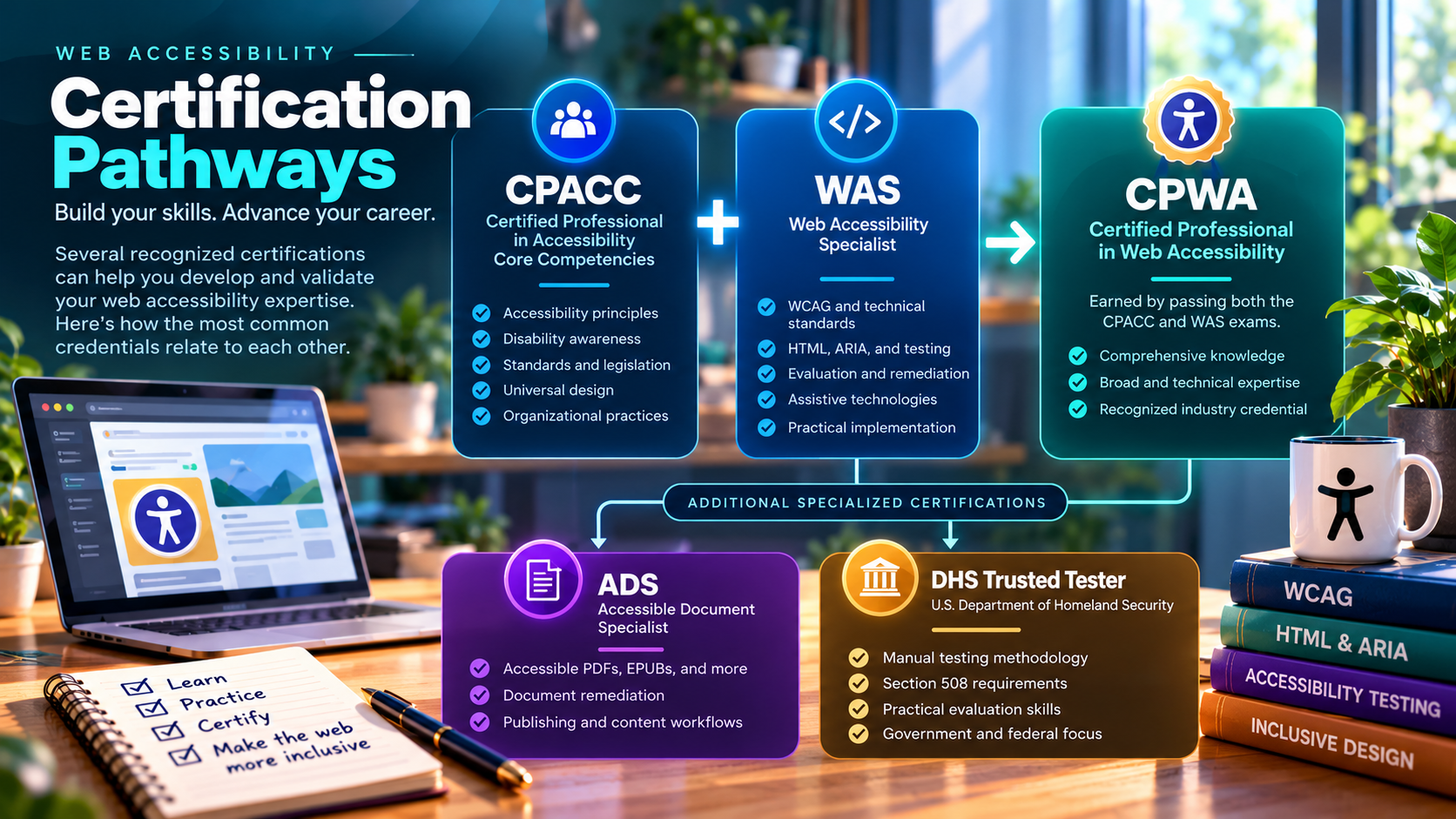
The International Association of Accessibility Professionals (IAAP) offers credentials covering accessibility foundations, technical web accessibility, and accessible documents. These are useful starting points when comparing professional certification routes.
CPACC: Certified Professional in Accessibility Core Competencies
Focus: foundational accessibility knowledge, disability, assistive technology, inclusive design, accessibility standards, and organizational considerations.
Best for: accessibility coordinators, designers, product managers, consultants, content professionals, and people entering the field.
CPACC emphasizes the broader context of accessibility rather than testing a developer's ability to fix a particular HTML or JavaScript issue. It can provide a foundation for people who need to make accessibility decisions across teams.
WAS: Web Accessibility Specialist
Focus: technical web accessibility, WCAG application, accessible implementation, testing, and remediation.
Best for: front-end developers, accessibility engineers, technical consultants, quality assurance professionals, and auditors.
WAS is particularly relevant to people who work directly with websites and web applications. Familiarity with semantic HTML, CSS, JavaScript, keyboard interaction, accessible names, and WAI-ARIA helps make the material meaningful.
CPWA: Certified Professional in Web Accessibility
Focus: the combined breadth of accessibility core competencies and technical web accessibility.
Best for: experienced accessibility consultants, senior specialists, and professionals whose work spans strategy and implementation.
CPWA is a combined credential earned by holding both CPACC and WAS; it is not a separate third examination. It can be a useful longer-term goal for someone building a comprehensive web accessibility practice.
ADS: Accessible Document Specialist
Focus: accessible digital documents, document structure, remediation, and related accessibility practices.
Best for: document remediation specialists, publishing teams, government and education staff, and professionals producing accessible files.
ADS focuses on accessible digital documents and document remediation. While document accessibility is often part of a broader digital accessibility program, ADS is not limited to web content. It is particularly relevant when a digital experience includes PDFs, office documents, or downloadable reading materials. Check the current IAAP body of knowledge for the exact scope of assessed formats.
DHS Trusted Tester: a structured approach to web accessibility evaluation
The U.S. Department of Homeland Security's Trusted Tester program provides training and certification in a standardized manual testing methodology for web accessibility under Section 508. It is especially relevant to people evaluating websites for U.S. federal agencies or contractors.
Unlike a broad accessibility foundations credential, Trusted Tester concentrates on following a defined test process, recording findings, and applying repeatable evaluation procedures. It is valuable for auditors and quality assurance professionals, including those who also hold IAAP credentials.
Keep in mind: Section 508 testing and a comprehensive WCAG evaluation are related, but not identical in scope. A Trusted Tester credential should not be presented as a guarantee of expertise in every accessibility standard, technology, or disability experience.
Accessibility courses and training certificates
Not everyone needs to begin with a professional certification exam. Courses can be a more approachable way to develop knowledge, prepare for an exam, or learn specific technical skills.
W3C WAI: Digital Accessibility Foundations
The World Wide Web Consortium's Web Accessibility Initiative (WAI) provides a free introductory online course designed for technical and nontechnical learners. An optional certificate is available through the course platform. It is a useful starting point for designers, developers, writers, advocates, and managers who want a shared vocabulary before specializing.
Explore W3C WAI digital accessibility courses
Deque University
Deque University offers structured accessibility training, including technical topics such as WCAG, accessible development, assistive technologies, and testing. Course completion certificates and professional exam preparation can be useful for learners who want a more guided pathway. Training completion should not be confused with earning an IAAP credential.
Explore Deque University training
Section508.gov training resources
The U.S. government's Section 508 resources include training and guidance for federal digital accessibility work. These materials can help content creators, developers, procurement teams, and accessibility practitioners understand the requirements and practices relevant to their responsibilities.
Explore Section 508 training resources
W3C WAI course directory
For a wider range of international providers, languages, audiences, and subject areas, W3C maintains a searchable list of accessibility courses, training, and certification opportunities. Entries are supplied by providers and others; inclusion is not a W3C endorsement.
Which accessibility program fits your role?
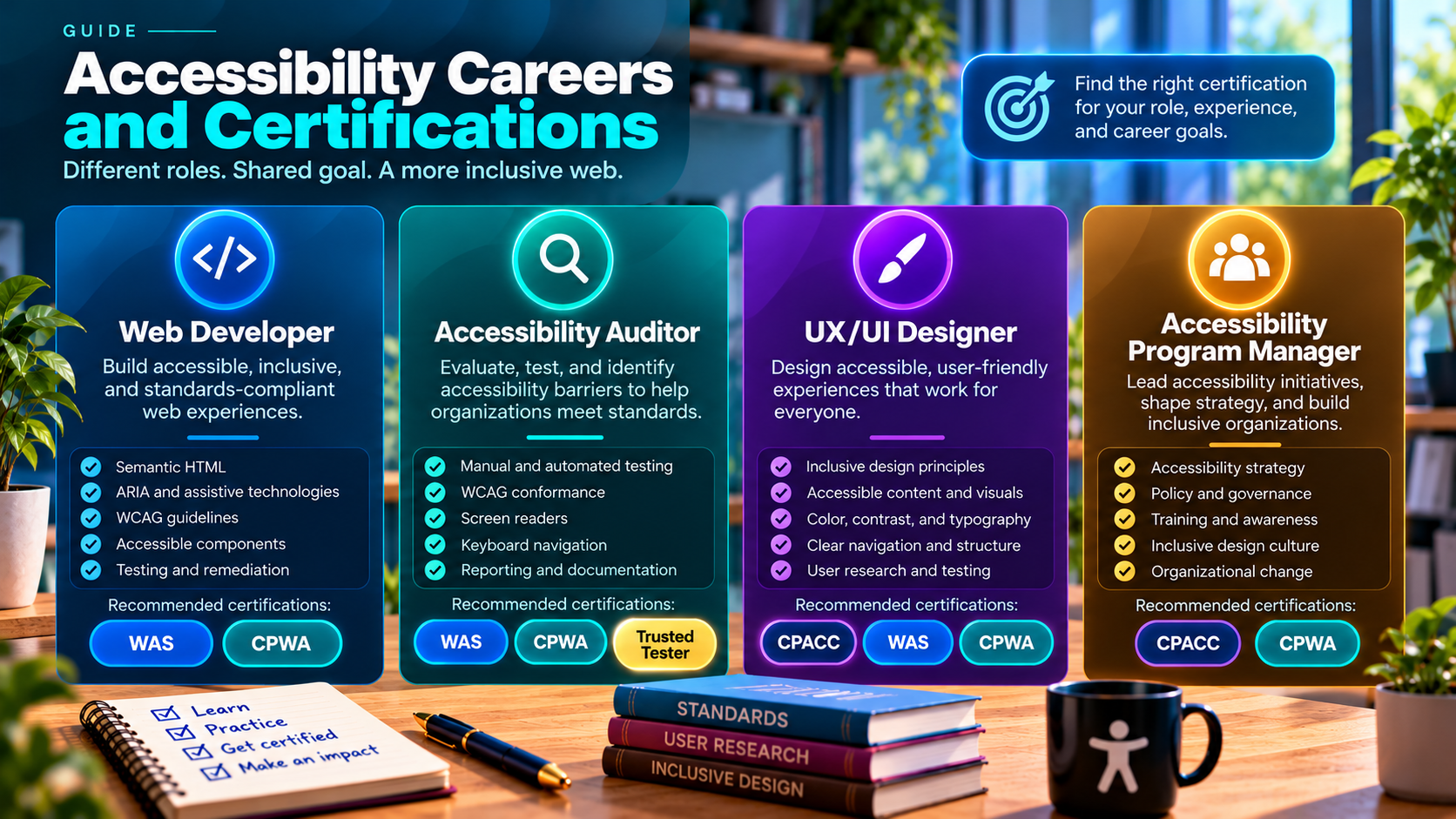
The following comparison is a starting point, not a ranking. A credential's value depends on the work you do and the skills you want to demonstrate.
| Goal or role | Programs to explore | Why they may fit |
|---|---|---|
| New to accessibility | W3C WAI Foundations; CPACC | Build an understanding of disability, barriers, and accessibility principles. |
| Web developer | WAS; Deque University | Strengthen technical implementation, testing, and remediation skills. |
| Accessibility auditor or QA tester | WAS; DHS Trusted Tester | Develop technical evaluation skills and repeatable testing methods. |
| UX or product designer | CPACC; targeted design training | Connect inclusive design principles to product decisions. |
| Accessibility manager or consultant | CPACC; CPWA | Combine organizational understanding with broader technical expertise. |
| Document and publishing specialist | ADS; document accessibility courses | Focus on creating and remediating accessible digital documents. |
| U.S. federal accessibility work | DHS Trusted Tester; Section 508 training | Learn government-specific evaluation processes and requirements. |
How to choose a certification or training program
Before enrolling, look beyond the name of the credential. A good program should align with the responsibilities you want to take on and provide a clear description of what you will learn or demonstrate.
- Define your goal. Are you preparing for a developer role, conducting audits, managing accessibility programs, or improving content production?
- Review the syllabus or body of knowledge. Check whether the program covers the standards, tools, and techniques relevant to your work.
- Understand the assessment. Determine whether the award requires a proctored exam, practical exercises, projects, or simply course completion.
- Check the full cost. Look for examination fees, membership discounts, course tuition, retakes, and renewal costs. Prices can change.
- Check accessibility and accommodations. Ask whether the course platform, materials, and examination process are accessible to you, and how accommodations are requested.
- Consider maintenance requirements. Some credentials require continuing education, renewal fees, or recertification.
- Plan for practical experience. Apply what you learn to real interfaces, use assistive technologies, and seek feedback from people with disabilities.
For a technical career, it may be more useful to combine one recognized credential with a portfolio of documented accessibility work than to collect several introductory course certificates.
Does certification mean a website is WCAG conformant?
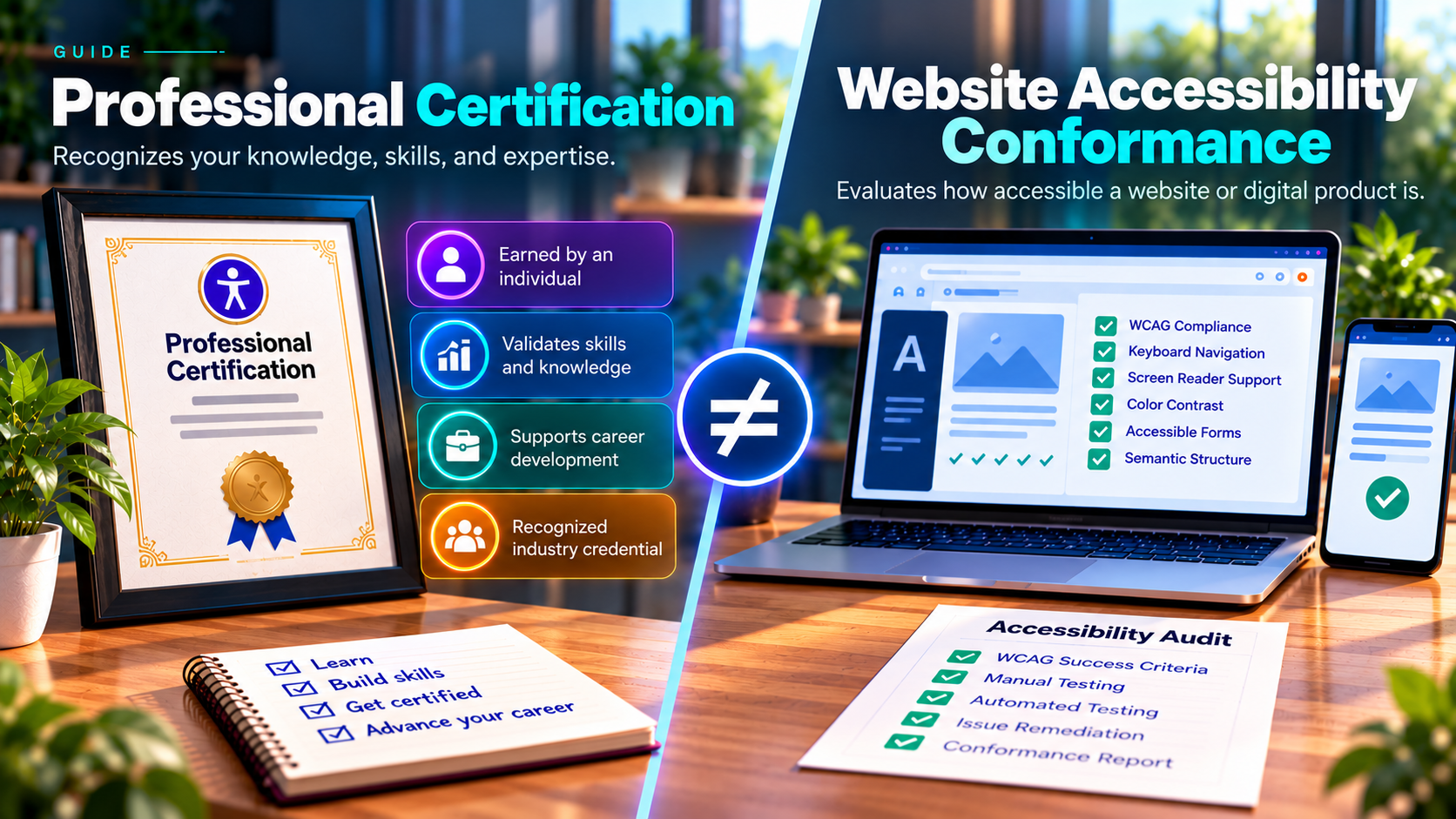
No. Professional certification evaluates a person's knowledge or competency against the issuing organization's criteria. WCAG conformance describes whether particular web content satisfies applicable success criteria at a specified conformance level and within a defined scope.
Even experienced certified professionals can make mistakes, and websites can change after an audit. A meaningful accessibility evaluation may involve automated checks, manual keyboard testing, screen reader testing, code review, and usability research with people with disabilities.
Be cautious about claims that a course certificate, accessibility badge, or automated scan alone proves a website is fully accessible. The quality of the evidence, testing scope, and remediation process matter more than the presence of a logo.
For standards guidance, consult W3C's WCAG overview and W3C's accessibility evaluation resources
Frequently asked questions
Do I need a certification to work in web accessibility?
Not necessarily. Many practitioners develop their skills through web development, design, quality assurance, disability advocacy, or direct experience using assistive technology. A certification can help demonstrate knowledge, but employers may also value practical experience and evidence of accessible work.
Should I start with CPACC or WAS?
CPACC is a logical starting point if you want broad accessibility foundations or work across design, policy, and management. WAS may be a better fit if you already have substantial technical web experience and want to demonstrate web-specific expertise. Check the current eligibility guidance before applying.
Please note: As a Calamnet word of advice, worldwide accessibility policies played a much larger role in the exam than we were led to believe prior to taking it. We highly suggest looking through the policies as a refresher before you take your proctured certification exam.
Is CPWA a separate examination?
No. IAAP's CPWA designation is earned by holding both the CPACC and WAS credentials.
Is DHS Trusted Tester the same as IAAP WAS?
No. Trusted Tester focuses on a standardized Section 508 web testing methodology, while WAS addresses a broader body of technical web accessibility knowledge. They can complement one another.
Are there free ways to begin?
Yes. W3C WAI provides a free introductory course, and W3C and Section508.gov publish extensive public learning materials. Optional certificates, formal examinations, and specialized courses may have associated fees.
Do certifications expire?
Some professional credentials have renewal and continuing education requirements. Rules differ between providers and may change, so check the current policies for the exact credential you are considering. As an example, CPACC certifications require 3-year renewals with 45 training hours, submitted and verified by the IAAP.
Official resources and further reading
- IAAP — professional certification information
- Section508.gov — Trusted Tester program
- W3C WAI — digital accessibility courses
- W3C WAI — course and certification directory
- Deque University — accessibility training
- W3C WAI — Web Content Accessibility Guidelines overview
- W3C WAI — evaluating web accessibility
Final thoughts
Accessibility is a practice, not a single exam. The most useful certification is the one that strengthens the work you actually do—and encourages you to keep learning. Whether you begin with a free foundational course, pursue IAAP certification, or train in a formal testing methodology, combine that education with practical testing, thoughtful design, and the experiences of disabled users.
Editorial note: This guide is informational and is not an endorsement of a particular provider. Credential names and trademarks belong to their respective organizations.